

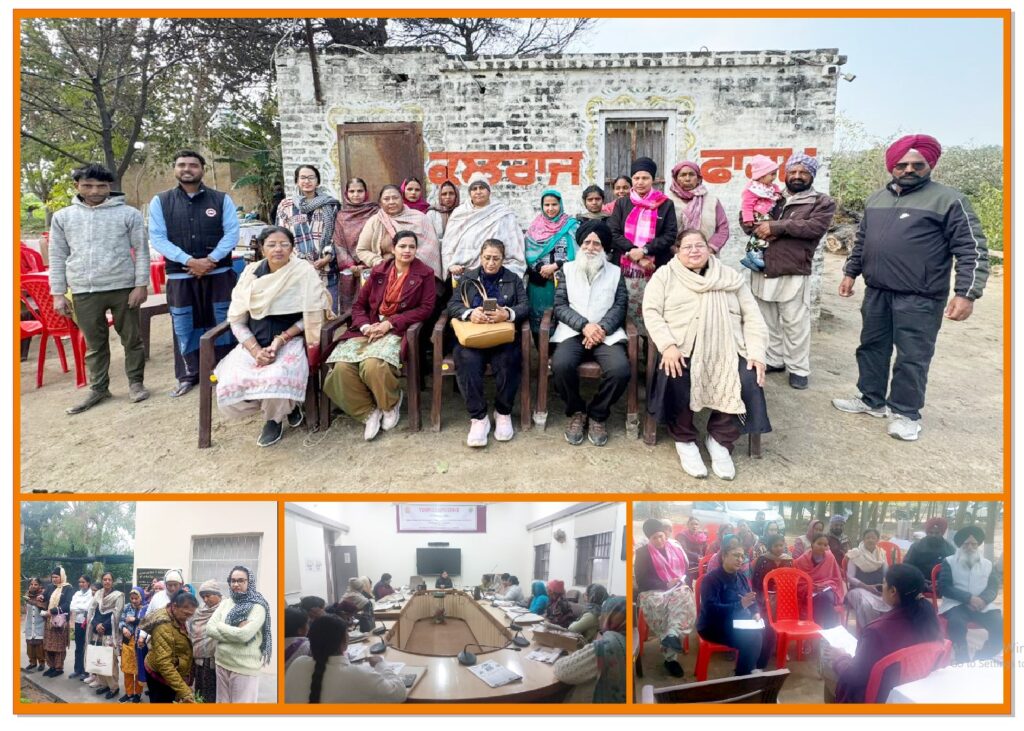
A three-day training programme on Vermicomposting was successfully conducted from 27th to 29th January, with the active participation of 15 women from Pakhowal village. The programme aimed at promoting sustainable farming practices and creating awareness about converting farm and household waste into valuable organic manure.
Dr K B Singh, Director PAMETI emphasized the need to step out of home and do some commercial activity that will make them financially independent too. As part of the training, the participants were taken on an exposure visit to the farms of Smt. Rupinder Kaur at Pakhowal, where they observed practical vermicomposting methods and learned about on-farm application of organic inputs. The visit provided hands-on understanding and encouraged the women to adopt the practice in their own fields and kitchen gardens.
During the programme, Dr. Harmeet Kaur, Training Coordinator, discussed various agri-business opportunities in vermicomposting, highlighting how women can prepare vermicompost at a small scale and sell it to nurseries and local farmers as an additional source of income.Another key highlight of the programme was an interactive session by Smt. Shelly, HDO, who elaborated on the various schemes of the Horticulture Department available for farmers and rural women. The session helped participants understand how government support can be availed for adopting sustainable and income-generating agricultural activities.
The participants also visited Gunta’s Vermicompost Unit at Bulara, which proved to be an eye-opener for many. The women learned how cow dung and other organic waste can be scientifically converted into high-quality vermicompost. The visit clearly demonstrated the economic and environmental benefits of waste management through vermicomposting.
The training programme helped the women realise that vermicompost can be easily prepared using locally available resources and can significantly improve soil health, crop productivity, and kitchen garden yields, while also reducing dependence on chemical fertilizers.
Overall, the programme was well received and motivated the participants to adopt vermicomposting as a sustainable, eco-friendly, and cost-effective practice in their farming activities.